The Twenty-One: The True Story of the Youth who Sued the U.S. Government over Climate Change by Elizabeth Rusch


Image #1: Book Cover 

The Twenty-One: The True Story of the Youth who Sued the U.S. Government over Climate Change By Elizabeth Rusch
Reviewed by: Kara, Janely, Dom, and Thomas

Review

        Elizabeth Rusch’s The Twenty-One: The True Story of the Youth who Sued the U.S. Government over Climate Change follows the landmark case of Juliana v. United States, wherein the titular 21 children, spearheaded by Oregon-based lawyer Julia Olson, come together to sue the United States government for failing to protect their safety in regards to the growing crisis of climate change. In The Twenty-One, we follow Olson and her growing team–under the name “Our Children’s Trust”–as they pull together accounts of children from across the United States directly affected by climate change. After beginning the case’s filing in 2015, we follow the next eight years of hearings and red taping, the U.S Government hindering Juliana’s chances at every turn, all the while the 21 continue to suffer the effects of climate change and promote change through activism. Their stories are a compelling account of the struggles children face growing up in the modern political and geological landscape, and how their voices are as important and vital to our future as any adult’s voice.

Image #2: Logo for Our Children's Trust

        The young plaintiffs are an eclectic group of kids, ranging from 7-year-old Levi Draheim to 19-year-old Kelsey Juliana. They come from all over the United States and from different backgrounds. Any reader should be able to find at least one person they identify with. Juliana v. United States is a youth-driven case and is a testament to what can be accomplished when children and adolescents come together to challenge the status-quo. At its heart, the story of the 21 plaintiffs is one of the right to live and grow when the world seems determined to prevent that. From the Obama administration to the Trump administration, the fight against climate change was never taken seriously, even as a 13-year-old Louisianan wakes to her room ankle-deep in floodwater. It’s thanks to these American youth that the fight against climate change takes a step forward in this country.
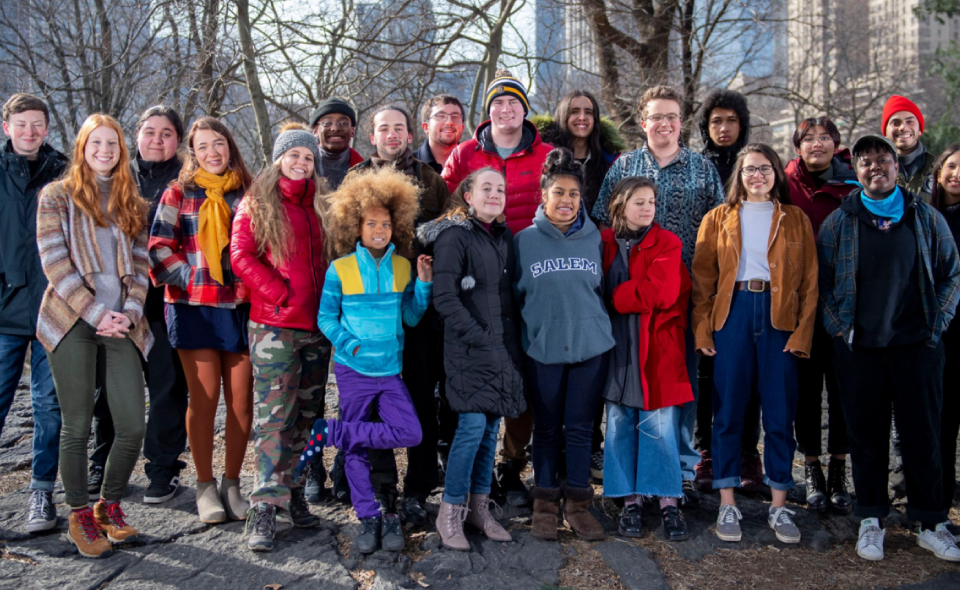
Image #3: The 21 Plaintiffs of Juliana v. United States

        Court cases and politics are often marred behind jargon, but Rusch chronicles the trajectory of the case in a far more digestible way. There are detailed descriptions for judicial procedures to be certain. However, they are always presented in the appropriate context and never take precedent over the state of the case’s position in the judicial system or the plaintiffs’ thoughts and reactions to their situation. When a roadblock or argument used against them is confusing to the kids, we’re there to ponder with them and learn the reasons for such tactics. Following the case through Rusch’s book provides an excellent insight not only to the workings of American politics but the art of debate and argumentation as well. Proof of damage is not enough to argue their case; their lawyers must argue that the U.S Government is actively contributing to the worsening climate by supporting the fossil fuel industry rather than not doing enough to combat it. This is a crisis that continues to affect our lives, and the youth of today will grow to carry the burden. This book has never been more relevant than right now. 


Image #4: A protest for Juliana v. United States

        The Twenty-One proves a valuable, informative, and inspirational read to many students, a great fit for classes focused on Earth Science, Politics, Debate, and many other subjects. It is inspiring to read of a group of young activists coming of age and taking the reins of their own fates in the best way they know how. Their protests continue in ways unique to each of them, such as Miriam Oommen’s physical activism that involves putting their body in the way of a pipeline operation, or Xiuhtezcatl Martinez’s environmentally conscious rap music organically spreading the message to his peers. They are the Davids to the governing Goliath and, regardless of the fate or trajectory of Juliana v. United States, they are a living example of how much agency the youth in America have, be it country, state, or county.

Author's Biography

Image #5: Elizabeth Rusch

Elizabeth Rusch was born in New York City, but grew up in South Carolina and Connecticut. Although she was an avid reader as a child, Rusch was not the best student in class. However, as she progressed through school, she became increasingly interested in the many topics her classes discussed. From legal cases to scientific studies, Rusch became fascinated with subjects such as Social Studies, English, and Science. After graduating high school, she went on to earn a degree in Economics from the esteemed Duke University, and immediately landed a job working for a start-up committee establishing a newly proposed national magazine for educators, named Teacher Magazine. Since she did not have a writing degree or any experience in the discipline, she was given the opportunity to become a Copy Editor after the magazine's publication. This pivotal position was the starting point in Rusch’s impressive writing career.

As a talented and passionate writer, Elizabeth Rusch has published over a dozen children’s books and more than one hundred articles for prominent publications like New York Times, Harper’s, and Smithsonian. Although her articles focus on adult conversations, her book publications vary in both topic and style. Rusch has written middle-grade, nonfiction, fiction, picture books, and graphic novels about the earth, space, colors, famous figures, and much more. She has received numerous awards for these works, including the Golden Kite Award, the Cook Prize, the Subaru Prize for science writing, the Green Earth Award, and the Oregon Book Award. She has also landed on many remarkable booklists, while also earning multiple star reviews from Horn Book, Kirkus Reviews, School Library Journal, and Publisher's Weekly. 

Rusch currently resides in Portland, Oregon with her husband and two children, and holds creative retreats at her beach house along the state’s coast. She also travels within and outside of the U.S. to give workshops at libraries and schools. Rusch's creative journey and passion for educating young adults and children on significant topics like climate change and political activism, is reflective in her work and daily life as she effectively and persuasively inspires others to embrace the knowledge of the world and be a part of change. More information and pictures regarding the life, travels, and works of Elizabeth Rusch can be found on her website linked below. 

Instructional Resources 


1. Juliana vs. United States 60 Minutes News Report: This video helps explains the landmark lawsuit Juliana v. United States, where 21 people are suing the U.S. government claiming its support of fossil fuels. This can give visual and narrative context for the lawsuit to help better understand both the legal arguments and their impact on the young plaintiffs.

2. Our Children's Trust: A nonprofit organization that supports young people in any legal actions aimed at protecting their constitutional right to a safe and stable climate. This can make a really powerful tool for teaching younger audiences how real-life activism and the justice for the environment can connect to each other.  

3. Filing a Lawsuit Instructional Video: This video helps break down how a civil lawsuit can begin, explaining the key players and the steps in filing a complaint, serving summons, and responding. Students can learn to understand the legal framework and of the procedural steps behind the type of case the young plaintiffs are pursuing. 

4. Climate Change Cause and Effect Video: National Geographic helps explains the effects of climate change and why it's happening. This will give essential background on the science of climate change, to better understand why the legal case matters, and what the plaintiffs are fighting to help address.

5. CNN Article: CNN covered a rally where the 21 plaintiffs protested outside a federal courthouse as their climate lawsuit faced delays and countless legal challenges. This can help students learn about real moments of public action, showing that these plaintiffs stood up publicly for their cause rather than backing down. 

6. Our Children’s Trust Suit Against US Government Surmounts Litigation Hurdle: Juliana v. United States achieved an early victory in the case, where the youth overcame a challenge that could've prevented their lawsuit from moving forward. This can demonstrate to students how difficult it is for a youth-led climate case to reach out, and highlights the significance of the case's progress. 

7. Greta Thunberg, schoolgirl climate change warrior: ‘Some people can let things go. I can’t’: This article profiles Greta Thunberg as a rising global climate activist, focusing on her refusal to stay quiet against the inaction towards climate change. This teaches younger audiences that, within a larger global movement of young people demanding climate justice, students don't have to be isolated when it comes to youth-led activism.
 
8. 21 American kids are suing the government for not doing enough about global warming: This article discusses the lawsuit against the U.S. government, which highlights the young plaintiffs arguing that government inaction on climate change threatens their futures and violates their rights.

Instructional Activity

Preview

The primary objective of this group project is to promote effective communication in students while simultaneously building their collaborative working skills in a group setting. Work on the project will begin once the class has finished reading and discussing the novel. For this assignment there will be "ideas" and "positions," where students will be assigned "pro" or "con" for a central debate topic and provide evidence supporting their claims. This group project should aid students in looking for scholarly sources, learning how to utilize those sources to support their evidence, and developing their skills to effectively evaluate, synthesize, and argue for a given topic or issue.

Grades: 7th grade - 12th grade (Middle school to High School) Classes: English, Government, Earth Science, Speech and Debate

California Common Core Standards

CCSS.ELA-Literacy.RH.11-12.2
Determine the central ideas or information of a primary or secondary source; provide an accurate summary that makes clear the relationships among the key details and ideas.
CCSS.ELA-Literacy.RH.11-12.3
Evaluate various explanations for actions or events and determine which explanation best accords with textual evidence, acknowledging where the text leaves matters uncertain.
CCSS.ELA-Literacy.RH.11-12.8
Evaluate an author's premises, claims, and evidence by corroborating or challenging them with other information.
CCSS.ELA-Literacy.RH.11-12.9
Integrate information from diverse sources, both primary and secondary, into a coherent understanding of an idea or event, noting discrepancies among sources. 

Resources and Preparation

Debate Team

Decide on issues for your students to debate. Allowing your students to select their topic of choice within that framework may also be considered. Organize two separate groups to research both sides of their respective issues using library databases or scholarly resources. Other means of organization such as a shared google doc to keep all their information together may be utilized.

Ex. Having only electric cars and no more gas cars, using solar panels for electricity.
  • 1 side: Pros - it doesn’t need gas, cleaner energy
  • 2 side: Cons - the cost to mass produce them and the financial situations that might prevent people from affording them 
This group project can take up to two weeks in order to allow students ample time to work on their cases as well as to seek help should they find themselves stuck. They should be given the time and space to practice their presentation and delegate points of focus and discussion to their respective members.

Provided Worksheet

                                                
Image #6: Evidence Sheet

Instructional Plan


Debate

Conduct the debate in your classroom. Make sure students practice proper debate procedures and follow any time restrictions for the activity to go smoothly and respectfully. This can be a lesson the teacher gives to the students beforehand to prepare them, as well as an opportunity to teach students about the branches of government and their roles and responsibilities. Select a winner after the debate has concluded (this could be a classroom-wide decision) and have students discuss the efficacy of the strategies both teams employed.


Mock Trial

Set up your classroom in the style of a courtroom and select students to perform the following roles: judge, lawyer, plaintiff, defendant, and jury. Consider alternating these roles per currently active and nonactive students in each debate. Another consideration could be to bring in another class undergoing the same lesson, though their participation would fall solely to the roles of the court. Make sure all students understand courtroom etiquette and procedures!


This is a great way to have students interact with important issues and engage in civil discussion while returning to the book for reference and guidance.

 
                Image #7: Visual discussion set up                                Image #8: Mock Trial

Bibliography

“Causes and Effects of Climate Change | National Geographic.” YouTube, National Geographic, 28 Aug. 2017, https://youtu.be/G4H1N_yXBiA?si=HO61nv1LGQr41pp4.

Elizabeth Rusch, www.elizabethrusch.com/.

“Filing a Lawsuit | Parties & Process - Lesson.” Study.Com, https://study.com/academy/lesson/video/starting-a-lawsuit-parties-beginning-process.html

Freedman, Andrew. “21 American Kids Are Suing the Government for Not Doing Enough about Global Warming.” Mashable, Mashable, 11 Apr. 2016, https://mashable.com/article/youth-climate-lawsuit.

Gundlach, Justin. “Our Children’s Trust Suit against US Government Surmounts Litigation Hurdle.” Climate Law Blog, 9 Apr. 2016, blogs.law.columbia.edu/climatechange/2016/04/09/our-childrens-trust-suit-against-us-government-surmounts-litigation-hurdle/.

“Juliana v. United States: The Climate Lawsuit.” YouTube, 60 Minutes, 23 Jan. 2020, https://youtu.be/Nm3EAPlT89I?si=o_HgtcewWLXYt_TK.

"Meet the Author: Elizabeth Rusch." Richland Library. https://www.richlandlibrary.com/event/2025-07-25/meet-author-elizabeth-rusch

“Our Children’s Trust.” Our Children’s Trust, www.ourchildrenstrust.org/

Sutter, John D. “Feds Try to ‘silence’ Kids Suing over Climate.” CNN, Cable News Network, 30 Oct. 2018, www.cnn.com/2018/10/30/health/sutter-climate-kids-rally.

Watts, Jonathan. “Greta Thunberg, Schoolgirl Climate Change Warrior: ‘Some People Can Let Things Go. I Can’t.’” The Guardian, Guardian News and Media, 11 Mar. 2019, www.theguardian.com/world/2019/mar/11/greta-thunberg-schoolgirl-climate-change-warrior-some-people-can-let-things-go-i-cant.

Images

Image #1: “The Twenty-One The True Story of the Youth Who Sued the U.S. Government over Climate Change.” Elizabeth Rusch, www.elizabethrusch.com/the-twenty-one

Image #2: "Our Children's Trust Youth v. Gov." Our Children's Trust, www.ourchildrenstrust.org/.

Image #3: "The 21 Plaintiffs in Juliana v. United States." Our Children's Trust, www.ourchildrenstrust.org/juliana-v-us.

Image #4: "Plaintiffs in Juliana v. United States." Oregon Encyclopedia, www.oregonencyclopedia.org/articles/juliana-v-united-states/.

Image #5: “Author Photos.” Elizabeth Rusch, www.elizabethrusch.com/author-photos

Image #6: "Evidence Sheet"

Image #7: "Visual Discussion Set Up", Shutterstock, https://share.google/Vxfoai1J0nc5TUx1a. 

Image #8: "Mock Trial", The Overlake School, https://www.overlake.org/about/news/729


Popular Posts